

OCC waste conversion to active carbon monoliths for adsorption applications
Transform OCC screen rejects into active carbon monoliths (ACMs) for efficient gas and liquid phase adsorption. ACMs can remove contaminants like VOCs and CO2 using direct Joule heating for regeneration, enhancing energy efficiency in environmental applications.
Overview
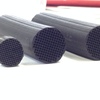
This innovative technology transforms old corrugated cardboard (OCC) waste into monolithic active carbon products that serve as efficient adsorbents. These active carbon monoliths (ACMs) are designed for continuous flow adsorption or reaction applications, capable of removing volatile organic compounds and CO2 from air or organic contaminants from water. The process leverages direct Joule heating for in-situ regeneration, providing an energy-efficient solution for both adsorption and catalytic reactions.
Technical specifications
Key features:
- Utilizes OCC waste to produce contiguous ACMs, potentially combined with other wood wastes
- Effective in both gas and liquid phase applications for environmental remediation
- Incorporates direct Joule heating for efficient regeneration and energy reduction
- Capable of supporting catalytic processes such as hydrogenation and CO2 conversion
- Customizable properties including surface area, porosity, and electrical conductivity
Technology readiness level
This technology is at TRL 4, indicating that the concept has been validated in a lab environment. Future validation will focus on processing OCC waste into ACMs and testing their performance in real-world adsorption applications, comparing them with existing ACMs made from other organic and waste materials.
About Monash University, Melbourne
Monash University is a comprehensive public research university and one of Australia’s largest, known for scale, interdisciplinarity, and an applied orientation. Its Melbourne-based technology precinct brings together university laboratories, pilot-scale and prototyping suites, and company R&D groups alongside government research organizations to enable co-development and rapid iteration. Integration with a major hospital network supports clinical trials and translation, while structured industry placements and doctoral partnerships create a robust talent pipeline for corporate R&D. Research is backed by competitive funding from the Australian Research Council, the National Health and Medical Research Council, and state and federal programs that incentivize industry collaboration. A dedicated technology transfer office manages IP, licensing, and startup formation, with pathways to incubation and investment within the precinct.
Inquire about this partnering listing
Industry applications

delivered to your inbox.