

Purification of organic acids using active carbon monoliths
Innovative purification method using active carbon monoliths (ACMs) to efficiently process fermentation broths. This method enables continuous flow adsorption of organic acids, followed by energy-efficient recovery through Joule heating, offering a sustainable solution for acid purification.
Overview
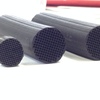
This solution leverages active carbon monoliths (ACMs) to purify organic acids from fermentation broths in a continuous flow system. The unique structure of ACMs, featuring high surface area and numerous small channels, allows for intimate contact with the broth and effective adsorption of small organic acids. The innovation lies in the regeneration of the adsorbent and acid recovery through Joule heating, which minimizes energy consumption and simplifies the desorption process.
Technical specifications
Key features:
- Active carbon monoliths (ACMs) derived from low rank coal and carbonaceous waste materials, ensuring sustainability and low impurity levels
- Customizable surface area, pore size distribution, and metal incorporation to tailor ACMs for specific applications
- Joule (resistive) heating in an inert gas stream for efficient regeneration and recovery of adsorbed acids
The ACMs are prepared through a patented process involving a homogenization step that yields homogeneous monoliths, which are then tailored for optimal performance in both gas and liquid phase applications.
Technology readiness level
This technology is at TRL 4, indicating that it has been validated in a laboratory setting. Future validation will focus on enhancing the ACM properties and optimizing the liquid chromatographic method for determining recovery efficiency, along with further tests on the selective desorption process via Joule heating.
About Monash University, Melbourne
Monash University is a comprehensive public research university and one of Australia’s largest, known for scale, interdisciplinarity, and an applied orientation. Its Melbourne-based technology precinct brings together university laboratories, pilot-scale and prototyping suites, and company R&D groups alongside government research organizations to enable co-development and rapid iteration. Integration with a major hospital network supports clinical trials and translation, while structured industry placements and doctoral partnerships create a robust talent pipeline for corporate R&D. Research is backed by competitive funding from the Australian Research Council, the National Health and Medical Research Council, and state and federal programs that incentivize industry collaboration. A dedicated technology transfer office manages IP, licensing, and startup formation, with pathways to incubation and investment within the precinct.
Inquire about this partnering listing
Industry applications

delivered to your inbox.