
- Background
- What we're looking for
- What we can offer you
- Q&A
We are a global leader in coatings, developing advanced solutions for durability, aesthetics, and performance across diverse industries, from construction to automotive and industrial applications.
Coil coating is a continuous, automated process used to apply coatings to metal sheets before they are fabricated into final products. This process is widely used across industries to enhance corrosion resistance, improve aesthetics, and add functional properties to metal substrates, which are later stamped, bent, and formed after coating application.
One of the key challenges in developing new coil coatings is ensuring that laboratory results translate effectively to real-world production conditions. In the lab, coatings are typically applied using the "drawdown" method, where a fixed amount of coating is spread across a substrate using a controlled applicator, such as a coating rod, to achieve a uniform film thickness. However, in a production environment, coatings are applied using high-speed applicator rollers, often exceeding 500 feet per minute (FPM). This discrepancy can cause inconsistencies in film properties, adhesion, flow, and overall coating performance when transitioning from lab to full-scale manufacturing.
An approach that better replicates production conditions within a laboratory setting would improve the predictability of lab results, reduce costly production trials, ensure a smoother transition from R&D to full-scale manufacturing, ultimately improving the performance and reliability of next-generation coil coatings.
We are looking to replicate real-world coil coating production conditions in a laboratory setting. This could involve a small-scale pilot line or alternative methods that mimic key industrial parameters. The diagram below illustrates the key parameters and setup of current customer line conditions, providing insight into the critical factors that must be replicated or simulated in a lab environment.
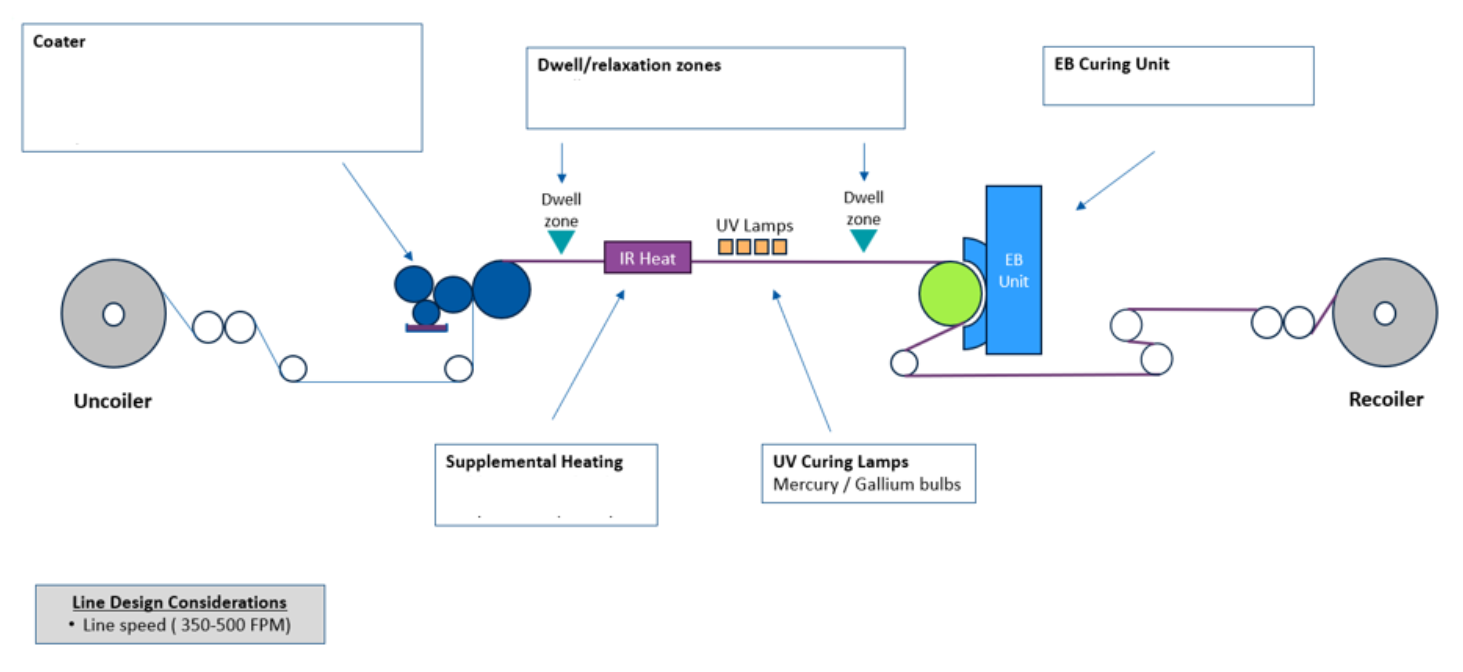 The ideal solution would be able to simulate coating applications in similar production settings while ensuring coatings meet key performance standards, such as appearance, dry film thickness, gloss control, adhesion, and flexibility—critical factors in predicting coating performance and ensuring consistency from lab to production.
- Pilot-scale coating line replicating critical process parameters
- High-speed roller for lab-based testing
- Alternative lab methods to simulate real-world application dynamics
- Novel application techniques that mimic high-speed industrial coating
- Accommodates aluminum or steel (HDG, galvalume) substrates
- Supports substrate thickness of 0.2-0.8mm
- Achieves dry film thickness of 0.2 mills (primer) and 0.8 mills (topcoat/clearcoat)
- Uses EPDM (ethylene propylene diene monomer) application rollers—polyurethane rollers are not acceptable due to swelling
- Includes a curing step (e.g., UV, thermal curing)
- Includes an electron beam curing unit
- Ability to test multiple curing methods in one setup
- Adjustable application parameters to match different production lines
- Manual roll application and drawdown methods, including wired bar coating
The Q&A is now closed.

Other recommended requests

delivered to your inbox.