

University of Minnesota
Minneapolis and Saint Paul, Minnesota, US
Summarized by Halo AI
Flagship public research university in Minneapolis–Saint Paul with co-located labs, an academic health system, a statewide extension network, pilot-scale facilities, and dedicated tech transfer. Anchored in a major medtech and Fortune 500 hub for fast industry collaboration.
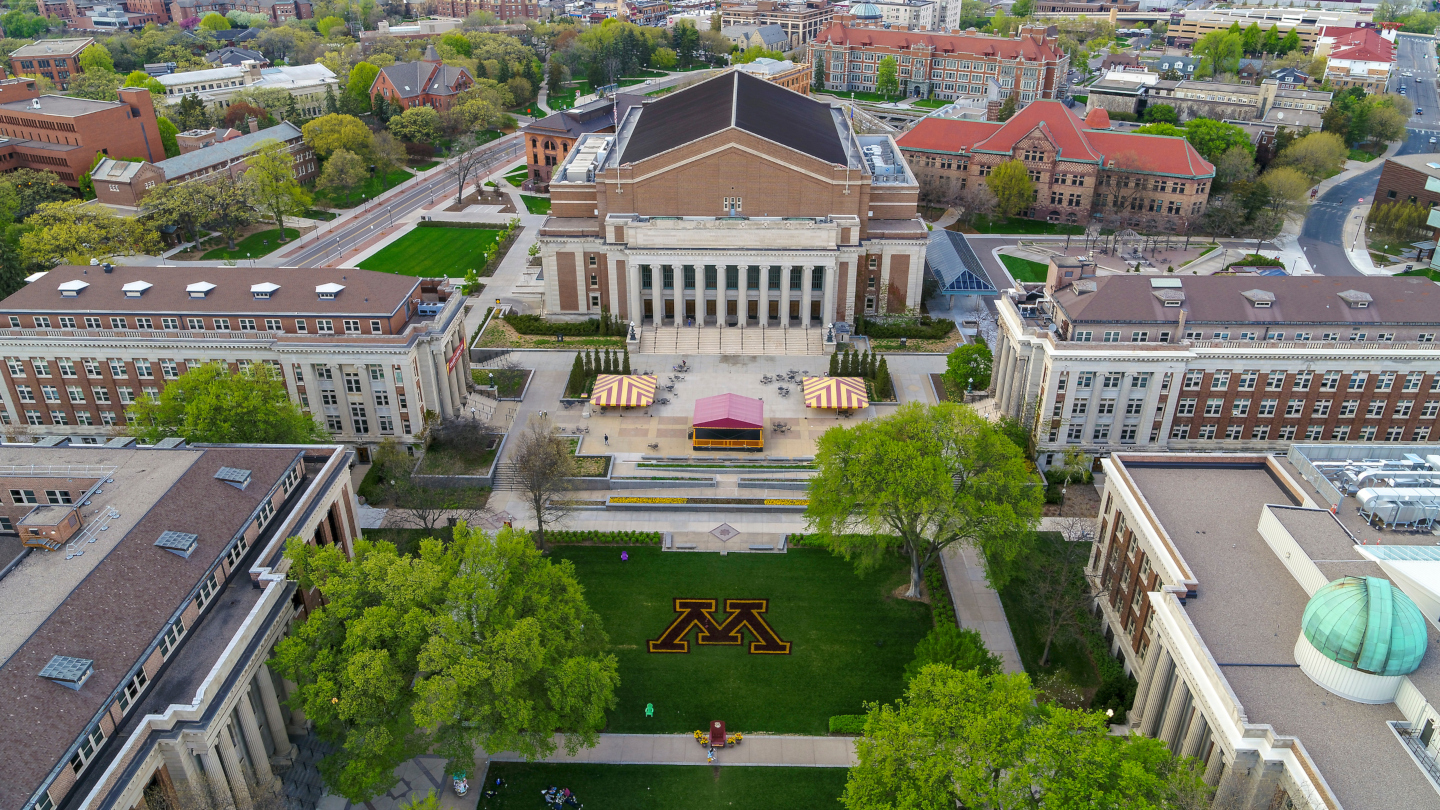
The University of Minnesota is a flagship, comprehensive public research university spanning multiple campuses, with a large research enterprise and clinical integration. Industry engages through co-located labs on the Twin Cities campuses, access to an academic health system for clinical translation, and pilot and field-testing facilities that speed scale-up. A statewide extension network and outreach centers provide real-world sites and data partnerships across Minnesota, while proximity to a dense medtech and Fortune 500 corridor enables frequent collaboration. Research is supported by competitive federal funding, including NIH, NSF, DOE, USDA, and DoD. A dedicated technology transfer office manages IP, licensing, sponsored research agreements, and startup incubation to speed commercialization.Top industry applications
Top industry applications are determined by Halo’s AI based on publication data and partnering evidence and are not influenced by the university. Read methodology.
Medicine
Medical diagnostics
University of Minnesota teams are building smartphone-powered CRISPR diagnostics and AI decision-support systems that detect disease at the point of care without costly lab infrastructure. Complementing these tools, they leverage deep-learning imaging analysis and circulating tumor DNA biomarkers to improve early cancer and cardiovascular detection. The portfolio addresses pressing needs for accessible, rapid screening and precision monitoring, creating clear pathways for commercial diagnostic platforms.Medicine
Medical imaging
University of Minnesota researchers are harnessing artificial intelligence to advance medical imaging, creating deep-learning tools for infant brain MRI segmentation and MRI-based models that predict muscle-invasive bladder cancer. They are translating quantitative neuroimaging into biomarkers for neurodegenerative diseases and deploying novel devices like autonomous ultrasound scanners that enable rapid point-of-care diagnostics. These innovations bridge academic imaging science with commercially viable solutions for pediatric, neurological, and cancer care.Digital & computing technologies
Artificial intelligence & machine learning
University of Minnesota researchers develop clinical AI, including diagnostic large language models, automated medical imaging, and electronic health record mining tools, to streamline healthcare delivery and improve patient outcomes. They also apply machine learning to accelerate materials discovery, precision agriculture, and advanced manufacturing, tackling industrial scalability and sustainability challenges. This work connects academic innovation to commercial markets in digital health, agritech, and industrial AI.Relevant Innovators
Keshab K. Parhi
Unclaimed
Artificial intelligence & machine learning
Artificial intelligence & machine learningM. W. Coughlin
Unclaimed
Artificial intelligence & machine learningBig data analytics & management
Artificial intelligence & machine learningBig data analytics & managementGeorgios B. Giannakis
Unclaimed
Artificial intelligence & machine learning
Artificial intelligence & machine learningMedicine
Surgical technologies
University of Minnesota researchers advance robotic-assisted and minimally invasive surgical systems, image-guided intervention, and intraoperative data platforms that turn individual procedures into continuously improving, outcome-linked learning systems. The work draws on the Institute for Engineering in Medicine, the Earl Bakken Medical Devices Center, and a December 2024 strategic partnership with Medtronic that explicitly targets medical robotics and AI-enabled surgery. As surgery shifts toward minimally invasive and robotic approaches across global markets, device and surgical-robotics companies gain access to clinical-grade testbeds, a deep medtech talent pipeline, and the federally designated Minnesota MedTech 3.0 hub.Agriculture
Plant breeding and genetics
University of Minnesota researchers develop winter-hardy oilseed and perennial crops—including domesticated winter camelina and pennycress—using molecular breeding, high-throughput genotyping, and genomic selection to create new low-carbon feedstocks and continuous-living-cover cropping systems for the Upper Midwest. The work is anchored by the Forever Green Initiative, which received a $2.5 million grant and a named multi-year breeding and genomics research partnership from Cargill, alongside support from the USDA, DOE, and the MBOLD coalition. Seed, trait, and renewable-fuel companies seeking regionally adapted germplasm and a pipeline from trait discovery to commercial variety release are the natural commercial partners.Relevant Innovators
CH
Candice Hirsch
Principal Investigator
Plant breeding and geneticsPrecision farming and smart agriculture
Plant breeding and geneticsPrecision farming and smart agricultureLR
Lucas Roberts
PhD Candidate
Plant breeding and genetics
Plant breeding and geneticsRS
Robert Stupar
Principal Investigator
Agricultural biotechnologyPlant breeding and genetics
Agricultural biotechnologyPlant breeding and geneticsMedicine
Pharmaceuticals and drug delivery
University of Minnesota researchers advance precision gene therapies using CRISPR base editors, TALENs, and AAV vectors to treat genetic diseases including epidermolysis bullosa and Pompe disease. They also engineer next-generation cell therapies and nanoscale drug delivery systems—such as micelles, DNA nanotubes, and mitochondrial transplants—to target cancer, neurodegeneration, and heart failure. Complementing these platforms is work in pharmacokinetic modeling and small-molecule drug design that accelerates clinical translation and biopharma manufacturing.Relevant Innovators
PO
Paul Orchard
Principal Investigator
Pharmaceuticals and drug delivery
Pharmaceuticals and drug deliveryCS
Changquan Sun
Principal Investigator
Pharmaceuticals and drug delivery
Pharmaceuticals and drug deliveryCW
Chun Wang
Principal Investigator
Pharmaceuticals and drug delivery
Pharmaceuticals and drug deliveryMedicine
Oncology & cancer therapeutics
University of Minnesota researchers are advancing CRISPR-engineered immune cells, CAR-T and CAR-NK therapies, and therapeutic cancer vaccines to target resistant blood cancers and solid tumors. They leverage AI-driven diagnostics, liquid biopsies, and proteomic profiling to personalize treatment selection and predict patient outcomes. Complementary work in irreversible electroporation, oncolytic viruses, and tumor-targeting nanomedicines aims to overcome drug resistance and expand the commercial toolkit for precision oncology.Relevant Innovators

Eric Rahrmann
Principal Investigator
Oncology & cancer therapeutics
Oncology & cancer therapeuticsSB
Suraj Bhattarai
Postdoctoral Scientist
Oncology & cancer therapeutics
Oncology & cancer therapeuticsJM
Juan carlos Rivera Mulia
Principal Investigator
Oncology & cancer therapeuticsRegenerative medicine
Oncology & cancer therapeuticsRegenerative medicineMedicine
Regenerative medicine
University of Minnesota researchers develop stem cell therapies, AAV gene delivery, and mitochondrial transplantation to treat Huntington’s disease, heart ischemia, and genetic muscle disorders. They advance tissue engineering through cryopreserved pancreatic islets, 3D-printed nerve scaffolds, and completely biological vascular grafts for coronary bypass and pediatric heart valves. These regenerative platforms target unmet clinical needs in organ replacement, neurodegeneration, and wound healing, opening substantial commercial opportunities in cell therapy and bioengineered medical devices.Relevant Innovators

Elizabeth Bradley
Principal Investigator
Chronic disease managementRegenerative medicine
Chronic disease managementRegenerative medicineCP
Christina Pacak
Principal Investigator
Regenerative medicine
Regenerative medicinePaolo P. Provenzano
Unclaimed
Medical diagnosticsPharmaceuticals and drug deliveryRegenerative medicine
Medical diagnosticsPharmaceuticals and drug deliveryRegenerative medicineLast updated by Halo AI Jun 28, 2026. Please verify key information. OpenAlex
OpenAlexAre you an admin at this institution? Claim this page and invite your faculty.
Claim your free page
Partner smarter. Move faster.
Get new partnering requests
delivered to your inbox.
delivered to your inbox.
© 2026 Halo Cures, Inc.