
- Background
- What we're looking for
- What we can offer you
- Q&A
Polyvinyl chloride (PVC) and ketone ethylene ester (KEE) bareback membranes, available in 50, 60, and 80 mil thicknesses, are single wrapped, then wrapped in sets of two. From there they are built into 4-packs. The 4-pack structure is built with a base layer of cardboard running the full length of the rolls, then two 2-packs stacked on top of each other, followed by another layer of cardboard also running the full length of the rolls, and then shrink-wrapped together for stability. These will go into the warehouse to sit until they ship out.
For truck transport, a layer of dunnage boards is put between the bed of the truck and the 4-packs to enable side unloading at job sites without loading docks. Another layer of dunnage boards is placed between each layer of 4-packs, arranged in a pyramid stacking pattern. Each layer of dunnage boards includes three boards, one on each end of the rolls and one in the center (see picture below). The truck driver will then put straps around the truck to secure the load.
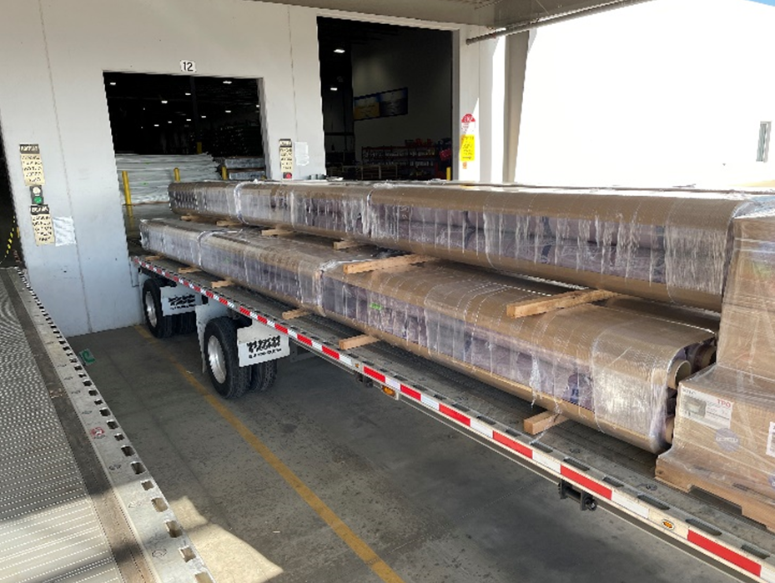
When 4-packs are set on dunnage boards we are introducing a leverage point. Over time, the dunnage boards create pressure points from the weight and straps on the membranes, causing them to conform to the board shape. This results in horseshoe-shaped indentations on the unrolled membrane. The deformation caused by the dunnage boards can lead to “fullness” or slight bulging along the edges of the sheet. This means the edges may warp or curve slightly upward, preventing the membrane from lying completely flat when unrolled.
We are looking for a product design solution to enable stacking rolls on separation layers for forklift lifting access, preventing material compression and deformation over time both during transport and longer-term customer storages.
- Reinforced wrapping or stackable protective casings
- Novel materials or geometries for dunnage boards
- Adjustable support structures that distribute weight and minimize compression
- Compression-resistant separation layers
- Innovative stacking configurations
- Innovative packaging
- Interlocking base systems that stabilize rolls and reduce pressure points
- Foam or gel-based cushions to absorb and distribute weight evenly
- Lightweight honeycomb panels
- Disperses forces evenly and reduces pressure points
- Eliminates deformation under measured forces determined during research
- Calculates the forces PVC and KEE membranes endure during transit and storage on dunnage
- Improves robustness of material packaging
- Compatible with existing packaging automation systems
- Minimal cost impact
- A model to predict packaging force limits to avoid deformation
- Changes to the base product design (membrane or core)
The Q&A is now closed.
Other recommended requests

delivered to your inbox.